Showing posts with label book. Show all posts

Wednesday, 15 July 2015

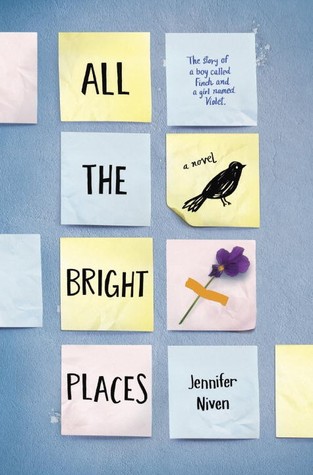
Review: All The Bright Places by Jennifer Niven

Age Group: YA
Genre: Contemporary
Pub Date: Jan 2015
Publisher: Penguin

All The Bright Places may be a book about depression, but it is anything but depressing. It deals with a lot of the stigma attached with mental illness, about the loss of loved ones, and finding hope in unexpected places.

We follow Finch, a troublemaker high-schooler who’s constantly in and out of the councillors office and school, and Violet, ex-cheerleader, ex-flute-player, ex-student-council-member. Violet is ex-perfect-student since the death of her sister nine months ago. They meet on top of a bell tower, when Violet is contemplating to kill herself. The story then follows them on a road trip to experience as many places their state has to offer.

The book isn’t by any means perfect. If you are irritated by quirky-character-syndrome, see Augustus Waters in TFioS, this may not be the book for you. Theodore Finch is obsessed by dying right from the start, telling us all about the different ways to go. He has a dramatic way of speaking, and changes his personality weekly. But he’s likeable. And so is Violet.

If you like the two comparisons that All The Bright Places was linked too: Eleanor and Park and TFioS, you will probably like this too. There’s a lot of comparisons between this and TFioS, which are fair in some respects and not in others. Yes, it has a similar style, yes it deals with usually taboo topics in YA, but they are still important topics to deal with. Niven occasionally handles the aspects of mental illness blunderingly, but from the authors note at the end, you can tell the experiences she writes about comes from truth.

All The Bright Places reminds us that between the episodes of sadness, there are pieces of hope. The book gets a bit troupe-y in places: see parent’s banning daughter, insta-love, slight case of manic-pixie-dream-girl/boy. However it throws in some brilliant ideas, the road trip is an excellent example. Violet and Finch try to pick up the pieces of themselves together, and in doing so you are reminded of the Bright Places that can exist in life.

There’s been a lot of criticism over the cotton-candy-style of writing, so I wanted to add my cents-worth. I personally liked Niven’s writing, I thought it was easy to read and differentiable between the two points of view. Niven was bold to touch a topic that hadn’t been handled much before in YA, so there is a need to make it accessible to people. Hopefully All The Bright Places will pave the way for bigger and better YA works on mental health and other stigmatised issues.

I know this sounds like a mixed review, and in all honesty I did like All The Bright Places. But maybe that’s because I’m a sucker for a quirky character and emotionally manipulating stories.


Rating: 7/10

I received a copy of this book from Penguin when I interned for them last year

Sunday, 10 August 2014

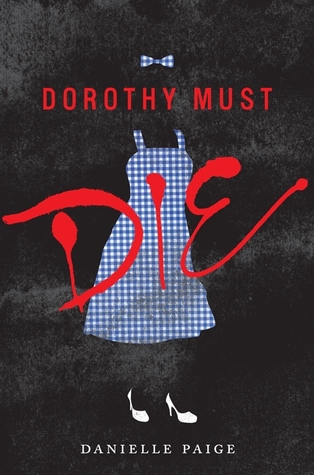
Dorothy Must Die

Dorothy Must Die (Dorothy Must Die, #1)
Age Group: YA
Genre: Fantasy
Pub Date: April 2014
Publisher: HarperCollins
                                                                                                               

Let’s start with a really shallow observation: I loved this cover. It really hit the spot with what the book was truly about; a cultural icon gone bad. I normally complain about books having a great premise and then never living up to its full potential. I’m pleased to report this is not the case with Dorothy Must Die.

Amy Gumm is a girl from Kansas (of course). Unwanted and feeling like she doesn’t belong, Amy is waiting for the day she can escape. Which she does. Through a tornado. Amy ends up in Oz with, her version of Toto, a rat called Star. But Oz is not what the Julie Garland film portrayed it to be. Gone are the chirpy munchkins and the Technicolor dreamland, replaced with darkness and despair, under the malevolent rule of Dorothy. Amy gets recruited by the Revolutionary Order of the Wicked for one task. That’s right, you guessed it, Dorothy Must Die.

Paige has altered the original world into is a fascinating one. The twists on all the well-known characters are clever, especially how the Wizards gifts have altered the Tinman, Scarecrow, and Lion. For some reason, Paige decided to overtly-sexualise Dorothy, probably a cheap shot to damage your childhood a bit more, but I’ll let that slide. It was all brilliantly twisted and morphed, from the freakish Perm-a-Smile (giving you a plastic grin) to the Tinman’s brutal army. 

The obvious comparison would be with Wicked (which I have not read, but I’ve seen the musical). While Wicked is more of a clever backstory to the Wizard of Oz, Dorothy Must Die is a whole new ballgame. The plot borders on a horror, with graphic scenes of violence, and this is a way Oz has never been imagined before. For a novel that was heavily borrowing on someone else’s world, it was really original.

Unfortunately the exceptional detail is also the books biggest downfall. It’s too long. 450 pages are way too many for this sort of novel. It felt like she was stretching it out for an unknown reason. Parts which made the novel so good, started to become wearisome.

Take Amy, I liked Amy. She was cool, and had an interesting voice. She had her flaws and she had her charms. She was well-rounded, compared to a lot of female characters I sometimes see. However after 300 pages, she started to grate on me. The sarcastic-I’m-a-fighter voice soon became I’m-trying-too-hard-by-being-sarcastic. The other issue with the writing was that there was so many colloquialisms in Oz from American culture, that made no sense for it being there. “Oz History 101” for example. Unless Oz is taking part is following the American educational system, which I doubt.

Overall I liked Dorothy Must Die. If you’re a fan of the Wizard of Oz or Wicked or just really cool retellings, and don’t mind some waffle, this book is for you. 

Rating: 8/10

I received this copy from Harper 360 in exchange for an honest review

Sunday, 6 July 2014

IBW Bookshop Crawl


The past week has been Independent Bookseller’s Week, and to celebrate it, I went on a bookshop crawl across London, with my friend Ayomide from ElliesAndPankcakes. So here is my guide to some of the finest London independent bookshops. But quickly, let’s talk about independents.

What is Independent Booksellers Week?
The week was part of the Books Are My Bag campaign, and is to celebrate independent booksellers.

Why are Independent Booksellers important?
I could go into a boring essay about economics and the free market, but nobody wants to read about that. There is more to it than Amazon killing bookstores. One thing I learnt from the crawl is how different the atmosphere and feel of an independent is compared to a commercial retailer. Every space crammed with old and new books, an independent radiates the love of a good story. I could have easily spent hours there browsing new treasures. If book buying wants to remain an experience, then independents need to stick around.

The Crawl


Any Amount of Books
“Any Amount of Books” was our first stop, and was almost overwhelming in the sheer amount of books that was present. As far as the eye could see, there were books. This was a bookshop I could imagine discovering an unexpected find, or a really nice edition of a beloved book.

Good for: Cheap and Rare books (their range is from £1 to thousands of pounds), Leather Bound and Decorative Books, Literary Fiction, Non-Fiction
Bad for: Mainstream and Young Adult fiction
Tube station: Leicester Square/ Tottenham Court Road

Henry Pordes Books
We were greeted by a friendly manager when we asked about IBW. Like “Any Amount of Books”, they sold all sorts of books, once again lined to the ceiling. I can imagine this shop would be useful if you wanted to do specific research on a topic, as they had an impressive non-fiction selection.

Good for: Non-fiction, Literary Fiction, Rare books
Bad for: Mainstream and Young Adult fiction
Tube station: Leicester Square/ Tottenham Court Road

Foyles
The mother of London independents, Foyles has long been one of my favourite bookshop in London. However, this was my first visit since their move and refurbishment, so I was excited to see the new store. Foyles lacks the cosy feel of other independents (the new regeneration looks like a bookstore from the future) but makes up with sheer range and variety of books. It’s easy to spend hours there.

Good for: Everything. You can find everything in Foyles. Mainstream and YA is particularly good here.
Bad for: Lacks the quaintness of other shops.
Nearest tube station: Tottenham Court Road

Hatchards
Full disclosure here, when I arrived in Hatchards I thought it was an independent. When I picked up the only book I was going to buy, I thought it was an independent. When I went to the till and discussed IBW, I found out it was NOT an independent. Irony at its finest. A quick Wikipedia search revealed that Hatchards was bought by Waterstones in the 90’s. However, it is a lovely bookshop, and if you fancy a look around I highly recommend.

Good for: Everything, like Foyles it has quite a range.
Bad for: Secretly not an independent!
Nearest tube station: Piccadilly/ Green Park

Heywood Hill
I hadn’t heard of this bookshop until I saw someone tweet about it on the day, and it was a great discovery. A world unto itself, minutes away from bustling Piccadilly, and tucked away on a quiet street, Heywood Hill has an enchanting atmosphere. Excellent rooms divided into genres, from the mainstream fiction as you walk in, to rare books, to my favourite room of all, the children’s room. This bookshop is a must-go if you love children’s and YA, the room even has a fireplace and fairy lights!

Good for: I saw a real range of books here. They specifically select new book to put out, so if you don’t have anything specific in mind, you’ll find something good here.
Bad for: If you have a specific book in mind, it may not be here.
Tube station: Green Park

Daunts Books
For some reason, Daunts always reminds me of Harry Potter. Not sure if it’s the wooden décor, or the piles of books, or the dim library, but I always get a sense that I’m in the Hogwarts library. Daunts seems to find the perfect balance between cosy and spacious, there are loads of recommendations and interesting finds, but the shop avoids feeling cramped. Then there is the upstairs, a balcony area around the shop, stacked with non-fiction books. Also makes a great photo-op!

Good For: Everything, great selection, great atmosphere. There’s also an interesting section organised by countries around the world.
Bad for: Struggling to think of anything…
Tube station: Baker Street

What did I buy?
OK, confession, I told myself I wasn’t going to buy anything before I went, because my TBR pile is big enough. That didn’t work out. I bought A Monster Calls by Patrick Ness for two reasons:  one, I love Patrick Ness, and two, A Monster Calls is a book which needs to be read as a physical book. It wasn’t something I could download on my kindle, I had to get in book form.


So there’s my bookshop crawl! Thanks to Ayomide for accompanying me, and check out her channel. I was going to film this, but I feared breaking the atmosphere by talking very loudly to a camera by myself. All my photos are from my Instagram, so for more bookish pictures, give me follow. Did you do a bookshop crawl? What are your favourite independents? Tell me below.

Monday, 30 December 2013

Updates and YA mini-reviews

You may have noticed that I have been absent from the internet recently. You may have not. If so, I’m not offended. So where have I been? University! Wooo!

I have been having a fantastic time. Such a fantastic time, that I now have no time. Between the 22 hours of contact time, the lab reports and coursework (this is what you get for choosing science), friends and extra-curriculars, I’m finding it to keep up, and I’ve just been lazy when it’s come to updating this blog and my Youtube channel. But with New Year’s around the corner, I am now determined to a better job of keeping up this blog and (hopefully) my Youtube channel. I say hopefully for Youtube because the walls in my halls of residence are so thin! So if anyone has some advice for me please let me know below.

I have also been a lazy reader. In the 3 months I was at university, I read three books one of which was on the train to and from London. To say I’ve been in a reading slump is to put it mildly. Luckily, the Christmas holidays have snapped me out of it, and I am on a roll.

So here’s the first part of my mini-reviews of what I’ve read.

Geek Girl and Geek Girl (Model Misfit) by Holly Smale
Geek Girl (Geek Girl, #1)Model Misfit (Geek Girl #2)Geek Girl has been floating around the blogging circuit for a while and I now know why, it’s amazing! It’s funny and quirky (and not in a look-at-me-I’m-so-hipster kind of way). Harriet Manners is a geek (as you may guess from the title) and somehow ends up as a model, which of course is followed by several mishaps. I loved Harriet, especially once you peel off all the layers of facts and knowledge she was a normal, teenage girl. Geek Girl doesn’t take itself too seriously, but has a lot of heart.
I received Model Misfit from NetGalley 
Rating: 9/10

Heist Society by Ally Carter 
Heist Society (Heist Society, #1)Heist Society had an interesting concept, as we follow Kat, a retired teenage thief whose father has been framed for a crime he didn’t commit. As much as I found the plot interesting, I felt like there wasn’t much to the characters. Kat was emotionless and lacked much of a personality, and I found it hard to connect to her. Even the plot, though fast paced and clever in places, required too much suspension of belief for me to take it seriously. It was fun to read, but ultimately left me feeling let down.
 Rating: 6/10

Clockwork Angel (The Infernal Devices, #1)Clockwork Angel by Cassandra Clare 
You may have noticed that I may be a tiney-winey (ok, massive) fan of The Mortal Instruments. So shockingly, I had not read the spin-offs. The reason for wanting to avoid them is that I’m not the biggest fan of historical fiction. Eventually I gave in and picked them up. I wanted to love it. Really, I did. And I did. Sort of. I really enjoyed the steampunk Victorian setting and the fast paced plot complete with a slippery villain. I loved all the characters, from book-loving Tess, to calm Jem, to strong Charlotte. The only problem I have is that I’m getting sick of love triangles. But I have high hopes for the rest of the series!
 Rating: 9/10


I have a lot of things coming up for this blog and I will get back into the swing of things, so stick around!

Sunday, 15 September 2013

Whistling Past the Graveyard by Susan Crandall

16058610Age Group: Adult (but it could be a YA read too)
Genre: Historical
Pub Date: July 2013
Publisher: Gallery Books
                                                                          
I’ve previously said how I’m not too keen on historical fiction. And every time I say that, I find a book that makes me change my mind. Whistling Past the Graveyard is a thought-provoking, emotional, witty novel set in the American Deep South in 1963.

Yes this book is about racism in 1960’s America. But it is also a coming-of-age story, about family and friendship. It also contains one of the most interesting POV’s in the genre, Starla, a nine-year-old, white girl. Being written from a child’s point of view, you may think that the writing would be too simplistic to enjoy, but Starla was full of personality. Her innocent view on the world was fascinating to see, and the comparisons to how she lived and the way the African-American’s did really highlighted the truth of the situation.  

The story follows Starla, who lives in Mississippi with her grandmother. Starla is fed up with her grandmother and wants to run away to Nashville to live with her mother. So she does exactly that. On her way she has a run in with Eula, a black lady who stole a white baby. And so they continue on their road trip together.

The characters were wonderful. Each had very strong, evocative voices. Starla was fiery and sassy, always questioning and never afraid. Eula perfectly contrasted with Starla, calm and stable, and was able to care for her in a way Starla never had before. Also, her background story was heart-breaking. But most important was the relationship that developed between them. Eula and Starla needed each other. Each had their lessons to teach to the other, and the transformation that happened was due to each other. At the heart of it, Whistling Past the Graveyard was about how friendship transcends the colour of skin and age.

Whistling Past the Graveyard had me on the edge of my seat. At some points it was so intense that I had to put the book down and think about what I had just read. There were so many strong messages in the book, but it was never in a preachy way. But I wouldn’t call it a dark novel. At some points it was funny, witty, and plain entertaining. It was the balance between grittiness and fun which made it so hard-hitting and memorable.

Overall: Even if you don’t like historical novels, I would recommend this to you. Whistling Past the Graveyard will make you think about life and race, and more incredibly it’ll come from the believable perspective of a nine-year old.

I received this book from Gallery Books via NetGalley in exchange for an honest review.

Rating: 10/10                                                    

Buy on Book Depository!

Monday, 2 September 2013

My Life Through Book Crazes

So The Mortal Instruments has just been released, and Divergent, The Fault in Our Stars, The Book Thief, and Vampire Academy are in the pipeline. It’s clear that now’s the time for Young Adult book adaptations. So as we reread and wait, I thought I’ll take a trip down memory lane and look at the explosion of adaptations that have become a phenomena in my life so far.

Harry Potter
I guess my story, as many others my age, starts with the unforgettable series that is Harry Potter. I read The Chamber of Secrets in 1999, after seeing the press surrounding The Prisoner of Azkaban. And before you say anything, yes I read the second one before the first because my mother brought me back the wrong book. At age 6, it gave me nightmares, and I didn’t touch another Potter book for two years, until the movie release of The Philosopher’s Stone. Harry Potter was a big part of many people’s childhood, and in my case I literally grew up with it, with the last film being released when I was 17. I think the key reason why people loved it so much was because even though it was about a fantastical world, it was so relatable. And the world was astonishing! The amount of detail that was in it made you really connect with the world, and dare I say it, believe it could exist.

Twilight
The year was 2006, and I was in a bookshop when I saw a mysterious black book with white hands and an apple. I was 13 and new to YA, and this book grabbed my attention with how adult it looked. I picked it up and saw the words “vampire” and put it straight back down. For me, vampires were something out of a horror story, completely terrifying (flash-forward seven years and I still can’t watch horror films). Nevertheless, I was intrigued by the story and bought it. And I was obsessed. Back then, only Twilight and New Moon was out, so I was counting down the days to Eclipse. Honestly, I cannot remember for the life of me why I loved it so much. Maybe it was the forbidden love idea. Maybe it was because I had never read paranormal romance before. In fact, two years later, I was completely off it, so much so that I didn’t go see the movie. Not that one person’s changed attitude to it mattered, because the rest of my all-girls school had gone nuts. On the opening day, I swear my whole class flocked to the cinema. If you want to know about my current opinion of Twilight, look at my Goodreads rating for it.

The Hunger Games
Okay, I was late to the Hunger Games party; I heard about it a few months before the film was released. I have to say, I wasn’t quite as into it as other people were, I don’t know if it’s because I hadn’t read the books that long before I saw the film. But I was blown away with how different it was to all the other YA I had read before. I think the reason The Hunger Games took off like it did was because it came at the right time. Twilight-mania had died down, and after years of Bella Swan being thrust in our face, Katniss Everdeen was a breath of fresh air. There was a female heroine girls could aspire to, and an incredible action packed story for everyone to get behind. It was dark and moving, and I’m not surprised it did so well.

The Common Denominator
Nothing. Well, there is something. People buy into a good story. Oh, we’ve had flops. Beautiful Creatures and The Host being this year’s ones. I think something to note is that all of these “crazes” have happened with good time between them. Yeah, there’s been some overlap, but none of them have happened too close together.  Also all three are remarkably different from each other, which is why movie people (though I doubt any of them are reading this), should be less focused with looking for “the next…” and get something original out. I know the reason I didn’t see/ read Beautiful Creatures was because I saw the trailer and thought, “it looks like they’re trying to sell this as the next Twilight”. One other link is that people know about the book before the film. I think that’s quite easy to forget in the book community because we are always talking to people who have read the books, but an example is, despite nearly everyone I know online having read Divergent and for sure, TFioS, I know a few of my friends haven’t even heard of the books, but would definitely enjoy them.


What I’m saying is… Well, I don’t really have a point here. Since I’ve grown up with the boom in book adaptations and mania, and have been part of it, I’ve always been interested in it. It’ll be great to know what everyone else thinks on the whole matter, so leave some comments below!

Sunday, 25 August 2013

One Step Too Far by Tina Seskis

Age Group: Adult
Genre: Contemporary/ Mystery
Pub Date: April 2013
17404760Publisher: Kirk Parolles
                                                                                          
If you asked me what the theme of this book was, I would have no idea. All I could say is “drama”. And that is because One Step Too Far has every type of drama possible, with a whole array of different characters.

We begin our story with Emily, a woman who is running away from her life in Chester to London, not for fame or fortune, but as a means of escape, using her handy birth name Catherine. Why? Well we have no idea. Then we meet Emily’s parents, Francis and Andrew, and we hear their problems, and then Emily’s “evil twin”, Caroline (no seriously, they’re identical twins). On top of that we have Ben, Emily’s abandoned husband, and Angel, Cat’s (Catherine wasn’t snazzy enough for her), troubled new best friend. And I haven’t yet begun on the different problems: anorexia, depression, psychosis, and that’s just Caroline. You add in everyone else’s issues and you have enough problems to fill several episodes of Jerry Springer.

All in all, One Step Too Far reads like a soap opera. Jam packed with lots of different issues, addictive to read, but at the heart of it, completely hollow. There was so much down in this book that I started to resent nearly all the characters and their miserable lives. As much as I was interested in their lives, I lacked any sort of empathy or connection to any of them. In fact, the only emotion I felt towards most of them was pity. It seems that Seskis was so focused on getting shade and depth into her characters that she forgot about the light.

Emily was our first person viewpoint, and when it jumped to another time or character the novel was in third person. This made it fairly easy to tell apart the different time periods with her, but made it quite confusing with telling apart the different points in time with the other characters. I also disliked the ridiculously long paragraphs and endless detail that Emily often provided, it was verging on stream of consciousness, and went past “setting the scene” to “irrelevant”.

I found the writing of the third person characters to be the best parts. Seskis seamlessly made very detailed, interesting (despite depressing) characters, and you could quickly spot the differences in their thoughts and voices. I found Caroline to be the most interesting, if not unlikable, and I was impressed with how Seskis really went back with Caroline’s history and how all her problems started.

It was only near the end of the book that I started to really enjoy myself. That was the point when the plot really kicked in and all the reveal came out, including one amazing omg-I-did-not-see-that-coming twist. And it was that which made it all worth it.

Overall: If you like soap operas you’ll love this book. Packed to the brim with enough drama to give EastEnders a run for its money, One Step Too Far may be a step too far, but its clever characters and interesting reveals make up for it.

Rating: 7/10

*I received this copy from Kirk Parolles via NetGalley in exchange for an honest review*

Thursday, 25 July 2013

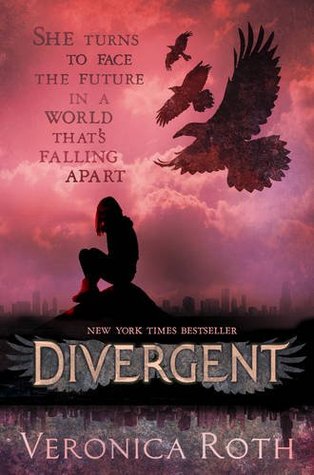
Divergent by Veronica Roth

Divergent (Divergent, #1)Age Group: YA
Genre: Dystopian
Pub Date: February 2012
Publisher: Harper Collins
                                                                            
I totally get the hype! However, I feel like it didn’t quite live up to everything I’ve seen about it. Don’t get me wrong, Divergent was a fantastic book, dull of everything I could have wanted from a dystopian novel: action, drama, and romance, and I really enjoyed it. My Youtube video explains why I didn’t feel it meet my expectations.

Divergent is about Tris, who lives in a world where everyone is divided into “fractions” based on their personality. Instead of choosing the selfless faction she was born into, Abnegation, Tris choses Dauntless, the brave nation. I really liked Roth’s world, I thought it was really clever, and thought-out, and I haven’t seen one like it. I would have liked more explanation about how the system came into place, but maybe that will happen in the sequels. 

The plot, pacing, and writing were amazing. It became addictive: I wanted to read on and on. There was never a dull moment in this book, as something was always happening. As much as the world was unique, I feel that the story wasn’t, but while I was reading it, I frankly didn’t care because I was having so much fun and there was enough twists to keep it unpredictable. The other reason why I didn’t care too much about the plot was because I felt the whole thing was about Tris and her discovery of herself.

Tris was a great female character. I often find dystopian books lose their sense of humour with the doom and gloom, but Tris was pretty funny. And good, and kind, and most importantly, flawed. I felt all of her actions were really true to her character; she was brave, yet not excessively heroic. Most importantly, despite living eons into the future, she was really relatable. She’s just a teenager struggling to find out who she is and where she belongs.

As for the romance? Well Four, Four, Four… It was impossible not to like Four. He’s got that whole bad-boy-with-a-heart-of-gold thing down. He also had great character development and loads of twists in his background. However, as much as I liked Four and Tris, I feel like there could have been some more background or development in the other characters. I would have loved to find out more about Tris’ family, or Christine, or even Eric. Roth created amazing characters, but left me hanging.

I think it’s the lack of connection I had with the other characters which gave me the emotional disconnection with most of the plot that wasn’t directly to do with Tris and Four. And this was the major flaw for me. The only emotion I felt during the whole book was “I’M SO EXCITED WHAT’S GOING TO HAPPEN NEXT”, while other dystopians have provided me with so much more.

Sum It Up: A must-read for dystopian lovers. I really loved the book, thought it was different and action-packed, but didn’t quite live up to the hype for me.

Rating: 8/10

Sunday, 21 July 2013

The Hundred Year-Old Man Who Climbed out of the Window and Disappeared by Jonas Jonasson

The Hundred-Year-Old Man Who Climbed Out of the Window and DisappearedAge Group: Adult
Genre: Humour
Pub Date: July 2012
Publisher: Hesperus Press
                                                                              
I think the best way to describe this book is a Swedish, black-comedy version of Forest Gump. The title sums up the beginning of the book pretty well, when Allan Karlsson leaves his nursing home and gets entangled in an adventure involving a suitcase of money, murder, thieves, a hot-dog retailer, and an elephant. The story is interspersed with tales from Allan’s past, involving some of the biggest events in history.

This is a very cleverly thought up book. I found Allan’s present day adventures fun, and his past was bizarre and strangely educational. I think the main issue with the plot was some of the jokes skimmed over the top of my head as I didn’t know enough of the 20th century history that was covered. I found the chapters I enjoyed the most were the ones that I had background knowledge too. However, there were lots of instances where anyone would find the situations hilarious, and as every good black comedy does, it made murder funny.

The main source of entertainment was Allan himself. He wasn’t a conventional comic character; it was his naivety and lack of interest (and fondness for vodka) that made him so funny. There was something unbelievable about him, the way he didn’t care for politics or religion or money, but it was that which made him a brilliant character. As for the supporting characters, well there was something a bit mad about all of them: whether it being a student in everything, or being a lack-wit that managed to take over a country. And it was the way that Jonasson made all these insane events seem realistic that made the book so engaging.

The only complaint I have is in the writing. I found myself loving the story, but at the same time I found the writing to lag or to have too much superfluous information. I ended up skipping over large paragraphs of text because I wasn’t that interested. If anything, this book did make me want to brush up on my history and politics, and I found it to be a good, unreliable source of events that I want to know about. The good thing about it being written by a Swedish author was that there was no British or American bias to the story, meaning that unlike Forest Gump, it was easier to get a fun and slightly more truthful story.

Sum It Up: A fun and witty story, perfect for those with an interest in history and politics, but for those who don’t, it can drag a bit.

Rating: 8/10

Wednesday, 17 July 2013

Zoobiquity by Barbara Natterson-Horowitz and Kathryn Bowers

Age Group: Adult
Genre: Popular Science
Pub Date: June 2012
Publisher: Virgin Books


A time ago I wanted to be a vet. So when I came across this book it sparked a curiosity in me. There are very few medical popular science books around, and even fewer veterinary related ones. And I have to say it was a truly illuminating book, and one anyone interested in medicine (be it animal or human) or science should read.

Although written by two authors, Zoobiquity is written from the perspective of Dr Natterson, a doctor, and her journey discovering comparative medicine. The book is very easy to follow, and you don't need a insane amount of scientific knowledge to read it (which in my experience, a lot of "mainstream" popular science requires). I'm only 19, but I could have easily read this book at 16.

Zoobiquity takes us on a journey comparing important issues in the medical community (obesity, cancer, STD's, mental health) with how they play out in the animal kingdom. And the facts you learn from it! Did you know dinosaurs got cancer? 

The way the book is written in an accessible way. The work doesn't feel "dumbed down", yet it doesn't make you feel stupid reading it. It's written in a friendly tone, with a few popular culture references, but sounds intelligent enough to be taken seriously.

More importantly, it feels like you're reading a revolutionary book. Right at the beginning, the book states that doctors and vets barely talk to each other, and I have the sneaking suspicion that she's right. This book is written to draw attention to the overlap between animal and human medicine, to encourage more discussion, and to look for ideas and cures outside the realms of the human hospital and into the natural world.

It is by no means an easy read, it requires you to think. But isn't that what you want from a good science book?


Rating: 9/10

Saturday, 13 July 2013

USA Book List!

Right guys, I’m off to the U.S of A in a couple of weeks, and I thought it may be fun if I do my favourite all-American books. Books which really capture my mental vision of America: freedom and sunshine and all that jazz, as well as my heart. So why don’t y’all come along with me with my book-trip across the states? I’ve also picked the bits from the books I would love to take with me.
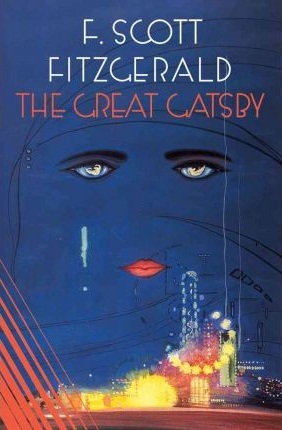
The Great Gatsby
The Great Gatsby
Do I need to say anything more? To me it showcased the good and bad of America, as well as taking me on an intense ride. This book showed the dark side of the American dream, yet there was something intoxicating about the lavish parties, and wealth and youth. There was something classy and gritty about it all, and I loved every second of it.
Take: Gatsby. Come on, who wouldn’t want him as a road trip companion?

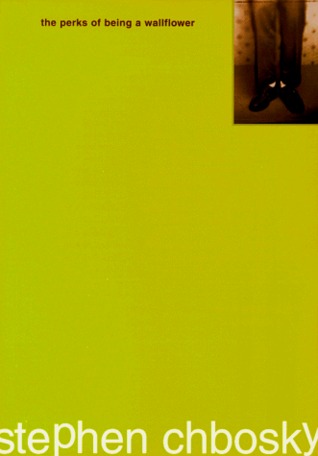
The Perks of Being a WallflowerThe Perks of Being a Wallflower
I have a confession: I’ve always wanted to go to an American high-school. Having said that, I have a feeling I would be more like Charlie out of Perks, than Regina George (bonus points to everyone who gets that reference). After spending most of my teens reading and watching sugar-coated American high school dramas, it was refreshing to read a book that resonated true to what could be an actual high-school experience.
Take: That famous “infinite” moment in the car with Charlie, Sam, and Patrick

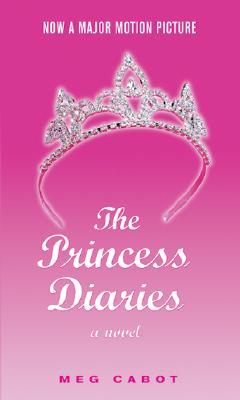
The Princess Diaries (The Princess Diaries, #1)The Princess Diaries
I’m quite a nostalgic person, and The Princess Diaries was the first American YA I read. It’s the book that caused me to fall in love with New York (despite never have being there), plus it was just so fun! I related to Mia so much (except the whole princess thing), and again it was me secretly living my dream of American high-school through her (I had a small obsession when I was a teen).
Take: Fat Louis. He’s a cool cat. And maybe a tiara…

To Kill a MockingbirdTo Kill a Mockingbird
This was the first American classic I read, and introduced me to the harsh reality of the South in that era. I think as much as I want to think everything is all sunshine and flag-waving, there’s a dark side to everything, and I felt To Kill a Mockingbird’s significance as I was reading it and found it a real eye-opener into racism in the USA.
Take: Atticus Finch (he’s just awesome)


Tell me what are your all-American books in the comments below!

Wednesday, 10 July 2013

Why YA is not a Scam

So yesterday, in a little corner of the internet, a debate happened on Twitter between Patrick Ness (@Patrick_Ness) and Shoo Rayner (@shoorayner). Patrick Ness is the award winning author of Chaos Walking, a dystopian YA trilogy, and Shoo Rayner writes for younger children. Rayner wrote a blog post on why he thought Chaos Walking was not suitable for children, the glamorization of violence in YA, and if YA is a genre caught up by the “glamour of Hollywood”. You can read the article here. Ness responded, and what resulted was an interesting, civil discussion between them.

I am utterly on Ness’ side with this, as I think Rayner has not acknowledged three things about YA literature. The teen reader, the purpose of reading, and why YA is necessary.

Let’s start with the teen reader, the target audience that Rayner had continuously failed to recognise. I think the confusion cropped up between the differences between teens and children. Rayner kept throwing around the fact that Ness had won the Carnegie medal (an award for children literature) despite his book being not aimed at children.

Hold up.

Legally in most countries those under the age of 18 are classed as children. Awards seem to work the same way. There are adult awards, and children awards. So under these technicalities, teenagers are children. That is why Ness’ book was in that category, because it is aimed at teenagers. Just because teenagers don’t fit into your idea of what children are, doesn’t mean they don’t exist in that category.

However, teenagers are not children under the definition of the word. We have higher cognition, understanding, and are going through some freaky changes (amiright?). And we need books to address this. For me the point of literature is not just to entertain, but to make you think and feel. So we need books that don’t talk down to us. Books that challenge us and make us think about society so when we are old enough to make a change we will. YA literature helps people who go through difficult times have something to relate to, it can give people a cause, or, in the case of Chaos Walking, make people look differently at the world.

And that’s why YA is not a scam. It’s not something made up by Hollywood to give adults something more exciting to read, or to make children grow up too fast. Books aren’t making children grow up fast. That fault is due to the internet, widespread information, and society in general. I am proud to have been a teenager in this era. In an era where I’m actually taking interest in what’s going on. Where I use information as knowledge and technology as a valuable tool. I don’t feel like I’ve “grown up” fast, and I would hate a person who does not know me to make a blanket judgement and say that I have.

I am now going to address Rayner’s idea that children and teenagers are being “conditioned to kill each other”. I’ve made it irrefutably clear several times on my Youtube channel and blog that I am a science student. I have looked this up and so far there has not been any concrete evidence of direct correlation between violence on screens and aggression in young people. So far, there has been evidence for aggression, calmness, and nothing at all. So Raynor, you’re telling me that in a medium that is less visual, it is going to affect my likelihood to be aggressive? In fact, books which portray aggressive protagonists may be helpful to society to help understand the individuals they are based on in reality. 

Novels and stories are exaggerations of real emotions and stories. That’s why they are exciting. Teenage assassin spies are brutal, but in an era of child soldiers and trafficking, are these books just not drawing parallels through issues going on in the real world to real children in far more awful consequences? We no longer live in the time of Enid Blyton, where everything will be solved by teatime and we’ll all sit down with some ginger beer. If anything the Famous Five is far more unrealistic than some modern day YA I’ve read. YA is there to address current issues, not to dwell in the irrelevant past.

As for Chaos Walking? I read The Knife of Never Letting Go when I was 14 in 2008, and continued to read on as the books were published. And I thought they were fantastic. I agree with Rayner in the respect that no, they’re not books about sunshine and unicorns, and yes they are very tragic and brutal, but unfortunately so is life for some people and children. The point of literature is to make you think and feel, as well as entertain. And boy, did those books do that.

There is a point which I do agree on in Rayner’s article. Is YA dominating children’s literature too much? I feel that for a while it has. YA is a relatively new category in the history of literature, and maybe that’s why there has been such a boom in it. When I look back to my childhood reading, I can only think of the classic books I read (okay I admit, I read a lot of Enid Blyton). Having said that, the most successful book of this generation is a middle-grade book, Harry Potter. I think middle-grade and younger children’s books are going to see a rise now that the hype of YA has died down a little. Books like Percy Jackson and the Fairyland series are excellent books enjoyed by all ages, and I think plenty is still to come.

Ness and Rayner brought up an excellent debate on Twitter, and you should check the whole thing out. However the whole issue boils down to the categorisation of teenagers by adults. We are not children, and we are not adults, but we do have a voice, and we do deserve to be heard. And that is fundamentally why YA is so important.

Sorry for the rant guys, my blood was boiling over this. Please leave some comments and join in the discussion!


Note: Rayner has written a follow up article here. I would love to rant about how he thinks scientific evidence is invalid due to who paid for it, but I won’t. 

Monday, 8 July 2013

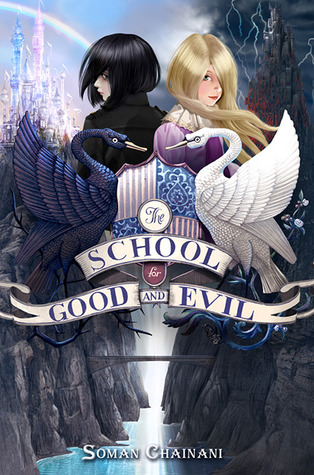
The School for Good and Evil by Soman Chainani

The School for Good and Evil (The School for Good and Evil, #1)
Age Group: Middle-Grade
Genre: Fantasy
Pub Date: May 2013
Publisher: HarperCollins

I really wanted to love this book. Really. I saw in in a bookshop and immediately fell in love with the cover and concept, and I was over the moon when I saw it was available on NetGalley (thank you Netgalley and HarperCollins for this copy). But I didn’t love this book. It was one of those cases of “concept much better than execution”, and left me unimpressed in the way it carried out its so-called messages.

The School for Good and Evil follows Sophie and Agatha, and their entrance into the title’s School for Good and Evil. The school is to train villains and heroes to star in their own fairy-tales. Sophie is beautiful and seems like a perfect princess, and Agatha is ugly and should be a witch. Shock horror, Sophie lands in Evil, and Agatha lands in Good. The rest of the book follows them taking part in classes, and trying to get to where they belong.

Let’s start with the good points: the plot and writing. Despite the issues I had with the rest of the book, I found it an engaging read, and well written. Chainani created a brilliant world, and despite the parts I found confusing, I kept on wanting to keep reading on. He is also a great writer, with enough description to make me see the world, witty one liners, and lots of colourful and fun ideas.

Sadly, that is not enough to carry the book.

I found this book preachy and confusing. Whatever message it was trying to give was erased a few chapters on by a contradicting idea. The problem was that Chainani was dealing in extremes: pure good and pure evil, making it very hard to see what was a statement and what was exaggeration. For one, the Evers (“Good”) vanity was constantly criticised, which I find pretty preachy, yes being overly vain is a bad thing, but wanting to indulge in grooming and make up surely isn’t. Yet, there was no middle ground covered, except when Agatha got a makeover to find out nothing had happened except she was beautiful all along. This seemed to contradict his message that beauty is a not essential to be good, and I would have preferred to have seen Agatha come to terms with her looks that didn’t involve a fairy godmother. But was this all exaggeration?  Also it did not offer any clear reasons for why people were good and evil. Were they just born like that? I kept waiting for a reason for Sophie’s actions, but never got one.

That was another issue, the inconsistency in Sophie. Agatha I liked, she was a well-rounded character, funny and flawed, and more importantly I understood her. She wasn’t pure good, but just good enough. Sophie was a mess. As I said before, I could not understand anything she did. Everything seemed to boil down to an obsessive need for Happy Ever After and vanity. Yet the only explanation was that she read a lot of fairy tales and wanted to get out her hometown. One moment Sophie was desperate to prove how good she was, the next she was the Ultimate Evil. This made her a good plot device, but an awful character.

Was this a good middle-grade book? I probably wouldn’t give it to an 11 year old. If you want to offer a good fairy-tale twist, there are better things out there (check out Cathrynne Valance). I found it confusing and I was way above the age-range. Nevertheless, it was exciting, fun, and sometimes very clever, so I guess my summary of this is just as inconsistent as the book itself.

Sum It Up: An erratic story with a fairy-tale twist. It makes an interesting read, but don’t expect anything too deep.

Rating: 5/10

*I received this copy from HarperCollins via NetGalley in exchange for an honest review*