Showing posts with label fairytale. Show all posts

Sunday, 10 August 2014

Dorothy Must Die

Dorothy Must Die (Dorothy Must Die, #1)
Age Group: YA
Genre: Fantasy
Pub Date: April 2014
Publisher: HarperCollins
                                                                                                               

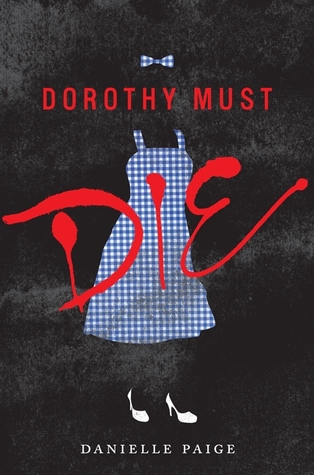
Let’s start with a really shallow observation: I loved this cover. It really hit the spot with what the book was truly about; a cultural icon gone bad. I normally complain about books having a great premise and then never living up to its full potential. I’m pleased to report this is not the case with Dorothy Must Die.

Amy Gumm is a girl from Kansas (of course). Unwanted and feeling like she doesn’t belong, Amy is waiting for the day she can escape. Which she does. Through a tornado. Amy ends up in Oz with, her version of Toto, a rat called Star. But Oz is not what the Julie Garland film portrayed it to be. Gone are the chirpy munchkins and the Technicolor dreamland, replaced with darkness and despair, under the malevolent rule of Dorothy. Amy gets recruited by the Revolutionary Order of the Wicked for one task. That’s right, you guessed it, Dorothy Must Die.

Paige has altered the original world into is a fascinating one. The twists on all the well-known characters are clever, especially how the Wizards gifts have altered the Tinman, Scarecrow, and Lion. For some reason, Paige decided to overtly-sexualise Dorothy, probably a cheap shot to damage your childhood a bit more, but I’ll let that slide. It was all brilliantly twisted and morphed, from the freakish Perm-a-Smile (giving you a plastic grin) to the Tinman’s brutal army. 

The obvious comparison would be with Wicked (which I have not read, but I’ve seen the musical). While Wicked is more of a clever backstory to the Wizard of Oz, Dorothy Must Die is a whole new ballgame. The plot borders on a horror, with graphic scenes of violence, and this is a way Oz has never been imagined before. For a novel that was heavily borrowing on someone else’s world, it was really original.

Unfortunately the exceptional detail is also the books biggest downfall. It’s too long. 450 pages are way too many for this sort of novel. It felt like she was stretching it out for an unknown reason. Parts which made the novel so good, started to become wearisome.

Take Amy, I liked Amy. She was cool, and had an interesting voice. She had her flaws and she had her charms. She was well-rounded, compared to a lot of female characters I sometimes see. However after 300 pages, she started to grate on me. The sarcastic-I’m-a-fighter voice soon became I’m-trying-too-hard-by-being-sarcastic. The other issue with the writing was that there was so many colloquialisms in Oz from American culture, that made no sense for it being there. “Oz History 101” for example. Unless Oz is taking part is following the American educational system, which I doubt.

Overall I liked Dorothy Must Die. If you’re a fan of the Wizard of Oz or Wicked or just really cool retellings, and don’t mind some waffle, this book is for you. 

Rating: 8/10

I received this copy from Harper 360 in exchange for an honest review

Monday, 8 July 2013

The School for Good and Evil by Soman Chainani

The School for Good and Evil (The School for Good and Evil, #1)
Age Group: Middle-Grade
Genre: Fantasy
Pub Date: May 2013
Publisher: HarperCollins

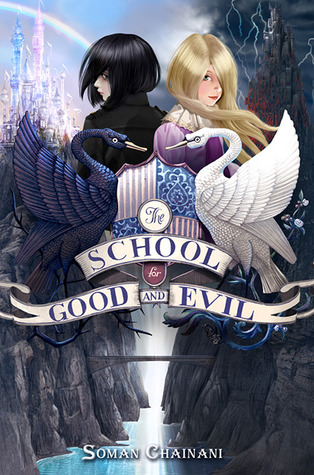
I really wanted to love this book. Really. I saw in in a bookshop and immediately fell in love with the cover and concept, and I was over the moon when I saw it was available on NetGalley (thank you Netgalley and HarperCollins for this copy). But I didn’t love this book. It was one of those cases of “concept much better than execution”, and left me unimpressed in the way it carried out its so-called messages.

The School for Good and Evil follows Sophie and Agatha, and their entrance into the title’s School for Good and Evil. The school is to train villains and heroes to star in their own fairy-tales. Sophie is beautiful and seems like a perfect princess, and Agatha is ugly and should be a witch. Shock horror, Sophie lands in Evil, and Agatha lands in Good. The rest of the book follows them taking part in classes, and trying to get to where they belong.

Let’s start with the good points: the plot and writing. Despite the issues I had with the rest of the book, I found it an engaging read, and well written. Chainani created a brilliant world, and despite the parts I found confusing, I kept on wanting to keep reading on. He is also a great writer, with enough description to make me see the world, witty one liners, and lots of colourful and fun ideas.

Sadly, that is not enough to carry the book.

I found this book preachy and confusing. Whatever message it was trying to give was erased a few chapters on by a contradicting idea. The problem was that Chainani was dealing in extremes: pure good and pure evil, making it very hard to see what was a statement and what was exaggeration. For one, the Evers (“Good”) vanity was constantly criticised, which I find pretty preachy, yes being overly vain is a bad thing, but wanting to indulge in grooming and make up surely isn’t. Yet, there was no middle ground covered, except when Agatha got a makeover to find out nothing had happened except she was beautiful all along. This seemed to contradict his message that beauty is a not essential to be good, and I would have preferred to have seen Agatha come to terms with her looks that didn’t involve a fairy godmother. But was this all exaggeration?  Also it did not offer any clear reasons for why people were good and evil. Were they just born like that? I kept waiting for a reason for Sophie’s actions, but never got one.

That was another issue, the inconsistency in Sophie. Agatha I liked, she was a well-rounded character, funny and flawed, and more importantly I understood her. She wasn’t pure good, but just good enough. Sophie was a mess. As I said before, I could not understand anything she did. Everything seemed to boil down to an obsessive need for Happy Ever After and vanity. Yet the only explanation was that she read a lot of fairy tales and wanted to get out her hometown. One moment Sophie was desperate to prove how good she was, the next she was the Ultimate Evil. This made her a good plot device, but an awful character.

Was this a good middle-grade book? I probably wouldn’t give it to an 11 year old. If you want to offer a good fairy-tale twist, there are better things out there (check out Cathrynne Valance). I found it confusing and I was way above the age-range. Nevertheless, it was exciting, fun, and sometimes very clever, so I guess my summary of this is just as inconsistent as the book itself.

Sum It Up: An erratic story with a fairy-tale twist. It makes an interesting read, but don’t expect anything too deep.

Rating: 5/10

*I received this copy from HarperCollins via NetGalley in exchange for an honest review*

Thursday, 27 June 2013

The Girl Who Circumnavigated Fairyland in a Ship of Her Own Making by Catherynne Valente

The Girl Who Circumnavigated Fairyland in a Ship of Her Own Making (Fairyland, #1)
Age Group: Middle-Grade
Genre: Fantasy
Pub Date: May 2011
Publisher: Much-in-Little

I first came by this book while I was walking along in Foyles. It immediately caught my eye with its deliciously illustrated cover and eccentric cover, but unsure, I walked on.

I couldn't get it out of my head though. There was something intriguing in the long name I couldn't quite remember, the vague promises of travelling to a faraway land, and eventually I gave in and bought it on my kindle. Best decision I made.

The Girl Who Circumnavigated Fairyland in a Ship of Her Own Making is a throwback to the time of fairytales with underlying commentary of a modern society. Toss in some lovely illustrations at the beginning of each chapter, and you have a book that will entertain all ages. 

The story is about September, a lonely girl who get's whisked away to Fairyland, where she sets out to retrieve a wooden spoon from the Marquess, and then gets entangled in a plot created by the Marquess herself. On her journey she meets Ell the wavererly (a cross between a wyvery and a library, don't ask), an utterly funny character. She stumbles across fairyland, encountering all sorts of creatures, which is told through a brilliantly self-aware narrator voice.

On the surface, this book may remind you of Alice in Wonderland (which I have to say, was the book of my childhood). However, where AiW was a book purely for the story, and without the meaning or morals that came with books of that era, TGWCFiSoHOM (too long?) is teeming with them. Whether it's commenting on the loss of childhood innocent and the cruelty of children and childhood, or death and the future, or indeed modern society with its layers of bureaucracy that disguise the people in powers hidden motives, TGWCF (better?) has meaning to it.

And that makes it special.

I think Valente wrote the book with the idea that parents would read it with their children, thus layering the meaning under the fun, but as a teenager I would recommend it too. It was nice, reading a book where a message could be conveyed in an entertaining way that wasn't layered with sex, drugs and violence. And even without all of that, it remained just as thought-provoking

Sum It Up: A brilliant take on a fairy tale that will enrapture all ages. Totally amazing!

Rating: 10/10