Showing posts with label children. Show all posts

Friday, 30 August 2013

Wonder by R.J. Palacio

17119852Age Group: Middle-Grade
Genre: Contemporary
Pub Date: Jan 2013
Publisher: Corgi Children's
                                                                            
August (or Auggie) Pullman is about to start his first year at middle-grade. However, unlike the rest of the kids starting middle-grade, this is going to be his first year at any school. The reason why? Auggie has a facial deformity, and enough medical conditions to fill an episode of House.

Auggie is a brilliant character; he is like any other 10 year old kid. He loves Star Wars, playing on his Xbox, and hanging out with his friends. It is his ordinariness in contrast with his illness which made the book so harrowing. Auggie knows exactly how people react to him, every gesture, every smile. He knows more medical words than me. So he created a bubble where he knows every person in his block to protect him from the world.

And school shattered that apart. Most of us have been to school. We know the story. The pain of fitting in, of finding your place. And we didn’t have Auggie’s face. But despite the stares and whispers, the cruel parents and school events, Auggie makes some friends. Wonder deals with the ordinary becoming extraordinary. Everyday events that you take for granted turns into torture for August, such as having school photos done or going to your sister’s play.

This book really highlighted that there are many types of people in the world. There are the good hearted ones, and then there are the ones who hate people for being different. But the world isn’t limited to that. There are people who are neutral, unsure, change sides and some who come out and surprise you. In a children’s book, you would expect a lot of black and white, but Palacio really highlighted the shades of grey.

Wonder is written from several points of view, which was important because it hits home the fact that Auggie isn’t the only person affected by his deformity. Via’s, Auggie’s sister, chapter highlighted this, as she struggled with her identity, and having to take care of herself, while defending and caring for Auggie. I thought all the characters were brilliant, and had their own unique view on life, which really contrasted against Auggie’s.

As a middle-grade book, the writing was fairly simple, yet there were enough variation to keep it interesting. The chapters are very short, and focuses on incidents, keeping you engaged. Then there were Mr Browne’s precepts, monthly ideas for his class to focus on, about kindness and truth, which really kept you focused on the theme of the story. As this book was for children, the book wasn’t as gritty as it could have been, but I don’t think that was the point. Wonder is about showing kindness, not shocking you with brutality.

This is a sad story, but it’s also happy, funny, thoughtful, and uplifting. And that rests in its sincerity. Nothing felt overdramatised, which would have been easy to do with a story which relies on children being cruel. I was taken on a journey of emotions with brilliant characters, and shown that the Wonder of people is not in how cruel they can be, but in how kind.

Overall: Just read it. Really, you won't regret it.

Rating: 10/10

Thursday, 18 July 2013

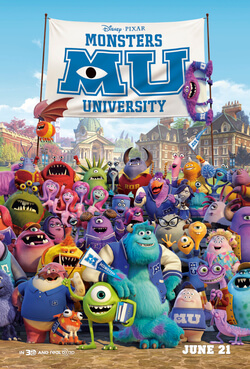
Monsters University (2013)

Director: Dan Scanlon
Producer: Kori Rae
File:Monsters University poster 3.jpgScreenwriters: Daniel Gerson, Robert L. Baird, Dan Scanlon
Starring: Billy Crystal, John Goodman, Steve Buscemi
Rating: U/ G

I have a strong feeling that my nostalgia for Monsters Inc. is going to bias this review, but I’ll say it anyway, I loved this film! There, I said it.

Monsters University is the prequel to Monsters Inc. and follows Mike and Sully before they became the scare duo of the original film, back to their “collage” years. Mike and Sully are initially enemies, due to Sully’s lazy attitude, and Mike’s lack of scariness. After nearly getting expelled, they are forced to compete in the “Scare Games” together, where they bond and discover what a great team they are.

Mike and Sully are as great as they were in the original. They contrasted each other and reflected a little bit of everyone. Pixar really tapped into everyone’s love of the underdog, and the supporting cast of Oozma Kappa was hilarious. Helen Mirren’s first voice acting role deserves a mention, as she was definitely the scariest monster of them all.

It’s very predictable up till the end, and for once I don’t care. Because Monsters University has all the charm, character, and wit of the original. It reminded me off my childhood love of Pixar, and the universality of its stories. Or maybe it has a little to do with me going to university this year… Was it the best Pixar film ever made? No. But Pixar’s bar is pretty high. The entertainment for adults as well as children was showcased through the film, with plithy remarks that were sure to skim over children’s heads but into adult mind. Most importantly, it tugged at your heart-strings. I genuinely cared about all the characters, and although I could guess at the ending, it didn’t make the journey any less enjoyable.

What I liked the most about the story was the message it sent out. In a society where a university degree seems like everything, and the attitude of “ you can do whatever you want to”, Monsters University took a daring stance on it. Despite studying his hardest, Mike was not cut out to be a scarer like he dreamed off, but he found out that there was something he was better at instead. The ending also showed that you don’t need a university degree to achieve what you want, but hard work and effort.

As for the animation? Pixar is upping its game with each production. Fur was a breakthrough back in 2001, but now the backgrounds are starting to look more like film clips from the real world. For me, the real testament of Pixar’s true ability was in the six-minute short film The Blue Umbrella before the main film, which not only showcased Pixar’s astonishing skills (for the first minute I honestly thought there was real world shots), but its ability to make you feel things you never thought you could.

Pixar may not be quite back to its former glory, but this film is a step closer to it, and gives me faith for Finding Dory, its next sequel.

Sum It Up: Funny and sincere, Pixar’s film will appeal to children, older original watchers of Monsters Inc. and adults. So really, it’s just for everyone.


Rating: 9/10

Wednesday, 10 July 2013

Why YA is not a Scam

So yesterday, in a little corner of the internet, a debate happened on Twitter between Patrick Ness (@Patrick_Ness) and Shoo Rayner (@shoorayner). Patrick Ness is the award winning author of Chaos Walking, a dystopian YA trilogy, and Shoo Rayner writes for younger children. Rayner wrote a blog post on why he thought Chaos Walking was not suitable for children, the glamorization of violence in YA, and if YA is a genre caught up by the “glamour of Hollywood”. You can read the article here. Ness responded, and what resulted was an interesting, civil discussion between them.

I am utterly on Ness’ side with this, as I think Rayner has not acknowledged three things about YA literature. The teen reader, the purpose of reading, and why YA is necessary.

Let’s start with the teen reader, the target audience that Rayner had continuously failed to recognise. I think the confusion cropped up between the differences between teens and children. Rayner kept throwing around the fact that Ness had won the Carnegie medal (an award for children literature) despite his book being not aimed at children.

Hold up.

Legally in most countries those under the age of 18 are classed as children. Awards seem to work the same way. There are adult awards, and children awards. So under these technicalities, teenagers are children. That is why Ness’ book was in that category, because it is aimed at teenagers. Just because teenagers don’t fit into your idea of what children are, doesn’t mean they don’t exist in that category.

However, teenagers are not children under the definition of the word. We have higher cognition, understanding, and are going through some freaky changes (amiright?). And we need books to address this. For me the point of literature is not just to entertain, but to make you think and feel. So we need books that don’t talk down to us. Books that challenge us and make us think about society so when we are old enough to make a change we will. YA literature helps people who go through difficult times have something to relate to, it can give people a cause, or, in the case of Chaos Walking, make people look differently at the world.

And that’s why YA is not a scam. It’s not something made up by Hollywood to give adults something more exciting to read, or to make children grow up too fast. Books aren’t making children grow up fast. That fault is due to the internet, widespread information, and society in general. I am proud to have been a teenager in this era. In an era where I’m actually taking interest in what’s going on. Where I use information as knowledge and technology as a valuable tool. I don’t feel like I’ve “grown up” fast, and I would hate a person who does not know me to make a blanket judgement and say that I have.

I am now going to address Rayner’s idea that children and teenagers are being “conditioned to kill each other”. I’ve made it irrefutably clear several times on my Youtube channel and blog that I am a science student. I have looked this up and so far there has not been any concrete evidence of direct correlation between violence on screens and aggression in young people. So far, there has been evidence for aggression, calmness, and nothing at all. So Raynor, you’re telling me that in a medium that is less visual, it is going to affect my likelihood to be aggressive? In fact, books which portray aggressive protagonists may be helpful to society to help understand the individuals they are based on in reality. 

Novels and stories are exaggerations of real emotions and stories. That’s why they are exciting. Teenage assassin spies are brutal, but in an era of child soldiers and trafficking, are these books just not drawing parallels through issues going on in the real world to real children in far more awful consequences? We no longer live in the time of Enid Blyton, where everything will be solved by teatime and we’ll all sit down with some ginger beer. If anything the Famous Five is far more unrealistic than some modern day YA I’ve read. YA is there to address current issues, not to dwell in the irrelevant past.

As for Chaos Walking? I read The Knife of Never Letting Go when I was 14 in 2008, and continued to read on as the books were published. And I thought they were fantastic. I agree with Rayner in the respect that no, they’re not books about sunshine and unicorns, and yes they are very tragic and brutal, but unfortunately so is life for some people and children. The point of literature is to make you think and feel, as well as entertain. And boy, did those books do that.

There is a point which I do agree on in Rayner’s article. Is YA dominating children’s literature too much? I feel that for a while it has. YA is a relatively new category in the history of literature, and maybe that’s why there has been such a boom in it. When I look back to my childhood reading, I can only think of the classic books I read (okay I admit, I read a lot of Enid Blyton). Having said that, the most successful book of this generation is a middle-grade book, Harry Potter. I think middle-grade and younger children’s books are going to see a rise now that the hype of YA has died down a little. Books like Percy Jackson and the Fairyland series are excellent books enjoyed by all ages, and I think plenty is still to come.

Ness and Rayner brought up an excellent debate on Twitter, and you should check the whole thing out. However the whole issue boils down to the categorisation of teenagers by adults. We are not children, and we are not adults, but we do have a voice, and we do deserve to be heard. And that is fundamentally why YA is so important.

Sorry for the rant guys, my blood was boiling over this. Please leave some comments and join in the discussion!


Note: Rayner has written a follow up article here. I would love to rant about how he thinks scientific evidence is invalid due to who paid for it, but I won’t. 

Monday, 8 July 2013

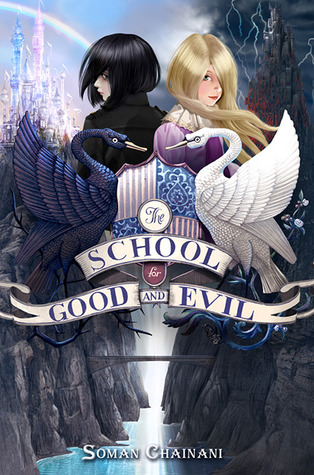
The School for Good and Evil by Soman Chainani

The School for Good and Evil (The School for Good and Evil, #1)
Age Group: Middle-Grade
Genre: Fantasy
Pub Date: May 2013
Publisher: HarperCollins

I really wanted to love this book. Really. I saw in in a bookshop and immediately fell in love with the cover and concept, and I was over the moon when I saw it was available on NetGalley (thank you Netgalley and HarperCollins for this copy). But I didn’t love this book. It was one of those cases of “concept much better than execution”, and left me unimpressed in the way it carried out its so-called messages.

The School for Good and Evil follows Sophie and Agatha, and their entrance into the title’s School for Good and Evil. The school is to train villains and heroes to star in their own fairy-tales. Sophie is beautiful and seems like a perfect princess, and Agatha is ugly and should be a witch. Shock horror, Sophie lands in Evil, and Agatha lands in Good. The rest of the book follows them taking part in classes, and trying to get to where they belong.

Let’s start with the good points: the plot and writing. Despite the issues I had with the rest of the book, I found it an engaging read, and well written. Chainani created a brilliant world, and despite the parts I found confusing, I kept on wanting to keep reading on. He is also a great writer, with enough description to make me see the world, witty one liners, and lots of colourful and fun ideas.

Sadly, that is not enough to carry the book.

I found this book preachy and confusing. Whatever message it was trying to give was erased a few chapters on by a contradicting idea. The problem was that Chainani was dealing in extremes: pure good and pure evil, making it very hard to see what was a statement and what was exaggeration. For one, the Evers (“Good”) vanity was constantly criticised, which I find pretty preachy, yes being overly vain is a bad thing, but wanting to indulge in grooming and make up surely isn’t. Yet, there was no middle ground covered, except when Agatha got a makeover to find out nothing had happened except she was beautiful all along. This seemed to contradict his message that beauty is a not essential to be good, and I would have preferred to have seen Agatha come to terms with her looks that didn’t involve a fairy godmother. But was this all exaggeration?  Also it did not offer any clear reasons for why people were good and evil. Were they just born like that? I kept waiting for a reason for Sophie’s actions, but never got one.

That was another issue, the inconsistency in Sophie. Agatha I liked, she was a well-rounded character, funny and flawed, and more importantly I understood her. She wasn’t pure good, but just good enough. Sophie was a mess. As I said before, I could not understand anything she did. Everything seemed to boil down to an obsessive need for Happy Ever After and vanity. Yet the only explanation was that she read a lot of fairy tales and wanted to get out her hometown. One moment Sophie was desperate to prove how good she was, the next she was the Ultimate Evil. This made her a good plot device, but an awful character.

Was this a good middle-grade book? I probably wouldn’t give it to an 11 year old. If you want to offer a good fairy-tale twist, there are better things out there (check out Cathrynne Valance). I found it confusing and I was way above the age-range. Nevertheless, it was exciting, fun, and sometimes very clever, so I guess my summary of this is just as inconsistent as the book itself.

Sum It Up: An erratic story with a fairy-tale twist. It makes an interesting read, but don’t expect anything too deep.

Rating: 5/10

*I received this copy from HarperCollins via NetGalley in exchange for an honest review*

Thursday, 27 June 2013

The Girl Who Circumnavigated Fairyland in a Ship of Her Own Making by Catherynne Valente

The Girl Who Circumnavigated Fairyland in a Ship of Her Own Making (Fairyland, #1)
Age Group: Middle-Grade
Genre: Fantasy
Pub Date: May 2011
Publisher: Much-in-Little

I first came by this book while I was walking along in Foyles. It immediately caught my eye with its deliciously illustrated cover and eccentric cover, but unsure, I walked on.

I couldn't get it out of my head though. There was something intriguing in the long name I couldn't quite remember, the vague promises of travelling to a faraway land, and eventually I gave in and bought it on my kindle. Best decision I made.

The Girl Who Circumnavigated Fairyland in a Ship of Her Own Making is a throwback to the time of fairytales with underlying commentary of a modern society. Toss in some lovely illustrations at the beginning of each chapter, and you have a book that will entertain all ages. 

The story is about September, a lonely girl who get's whisked away to Fairyland, where she sets out to retrieve a wooden spoon from the Marquess, and then gets entangled in a plot created by the Marquess herself. On her journey she meets Ell the wavererly (a cross between a wyvery and a library, don't ask), an utterly funny character. She stumbles across fairyland, encountering all sorts of creatures, which is told through a brilliantly self-aware narrator voice.

On the surface, this book may remind you of Alice in Wonderland (which I have to say, was the book of my childhood). However, where AiW was a book purely for the story, and without the meaning or morals that came with books of that era, TGWCFiSoHOM (too long?) is teeming with them. Whether it's commenting on the loss of childhood innocent and the cruelty of children and childhood, or death and the future, or indeed modern society with its layers of bureaucracy that disguise the people in powers hidden motives, TGWCF (better?) has meaning to it.

And that makes it special.

I think Valente wrote the book with the idea that parents would read it with their children, thus layering the meaning under the fun, but as a teenager I would recommend it too. It was nice, reading a book where a message could be conveyed in an entertaining way that wasn't layered with sex, drugs and violence. And even without all of that, it remained just as thought-provoking

Sum It Up: A brilliant take on a fairy tale that will enrapture all ages. Totally amazing!

Rating: 10/10